
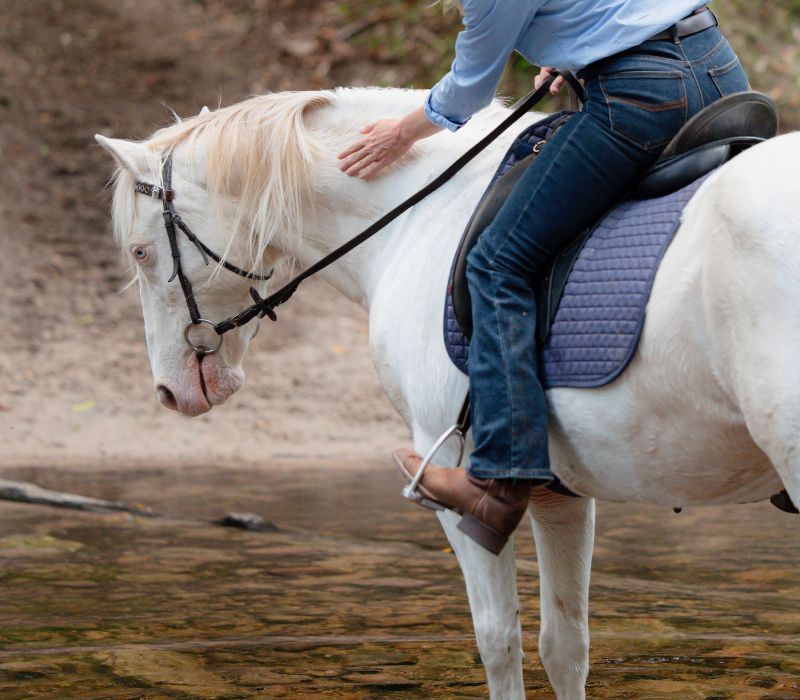
“I have the sweetest Icelandic horse. We almost only ride hacks and trails because that’s what we both enjoy and find fun. My problem is that he often during a ride (I recognize that it’s often when he gets confused, either because of a trail we sometimes take home or people standing still) stops and refuses to walk. He tends to love a good hack, especially with others, but he’s had this quirk for all 2,5 years i have had him. Just stopping a random time and not moving the tiniest bit. So I’m wondering what to do when your horse doesn’t react or want to go? How do I get him to walk without having to walk with him on the ground or kicking him?” – Frida
Hi Frida,
This is a tricky one to overcome in the heat of the moment without getting off and leading him forwards, however, there are lots of things you can do in the lead up and preparation.
What is key here is WHY your horse is doing this. You mention it’s on a specific part of the trail or when he sees people who have stopped and are standing still – I’ll go ahead and assume they are trail hikers who have stopped to the side of the trail to kindly let you pass right?
If he is doing it predictably, on certain parts of the trail, or when certain things happen (like the people ‘pulling over’ and standing to the side) then it all comes down to his confidence with certain triggers. Think of it like this: if he was in an arena and every time he came around the short side of the arena and saw, for example, a chair on the side, he would stop, then you would understand it was about his confidence moving past the chair. You would then gently let him explore the chair, and work on moving him past it. But the thing is, when the horses are out on a trail, there’s a lot going on – it’s often hard for us to pinpoint and identify why the horse is struggling to move forwards because we aren’t getting the same sensory input (as an example, our hearing is rubbish compared to our horse’s hearing!!)
So what can we practically do?
Practice working past ‘scary’ things. Because you can’t practice or recreate the exact trigger for him on the trail (the people), then we do the very next best thing: we work on teaching our horses that even when they are worried about something, we have a history of keeping them safe and successful.
So we practice with tarps on the ground, we practice with tarps on a fence post so it gently flaps in the breeze and moves unexpectedly. You could use any ‘prop’ or object to create some kind of reaction and gentle challenge for your horse. You can really use your imagination and get creative after a while, gradually increasing the level of challenge each object presents. It’s not about forcing the horse past these things, it’s about teaching our horse’s to trust our judgement and leadership when we ask them to move past something they think is scary. The relationship you build working on this kind of thing is everything, and sets the tone for how successful you hacks out on the trails. This is why he’s perfectly ok when he’s out with other horses – he trusts their judgement about whether he needs to worry or not. He trusts their judgement about how to approach a situation – he takes his emotional and physical cues from the other horses. Now, we just need to teach him to do that with you.
Now, this is not to say that you don’t have a great relationship already together – in fact, I am sure, from the way you’ve written and things you’ve described, that you already have a great bond together – to trust each other so well on the trail is a huge achievement! Think of this like a small area for expansion, to really deepen your bond!
What else can we use to ‘create challenges’?
- yoga balls
- umbrellas as ‘markers’ or points to ride to and from and around
- tarpaulins on the ground
- flags
- even Halloween decorations!
As we have just had Halloween here in Australia, it’s a great time to pick up some cheap props from your local store a few days after the holiday event. Why Halloween decorations? It’s a great time to buy skeletons! Skeletons are great to dress with a hat, shirt and jeans to look like people. They don’t have to be ‘scary’ at all but it’s a great way to access something ‘person’ like that you can introduce your horse to without having to drag you family members to your practice sessions! Think outside of the box – this seems unusual, but when done in a way that is kind and slowly, gradually builds your horse’s success and confidence, there are lots of fun ways to build confidence together.
I would always start introducing challenges on the ground before adding the ridden aspect to them and don’t get greedy with how much you expand your horse’s comfort zones each session. By practicing these skills of expanding comfort zones and working on challenges together, you have set up a pattern of behaviour at home first, with lots of successful training sessions, so that when you’re out on the trail, not only will you be able to help your horse follow your instructions and lead better with confidence, but you will also have experienced how he reacts when he is unsure, be able to then predict this, and respond more effectively and quickly to support him. This is also key to building his success and confidence.
- – Maddy
P.S if you’re unsure how to introduce challenging objects to your horse, we have a range of videos in our ‘Building Confidence’ module in our Subscription Library


