
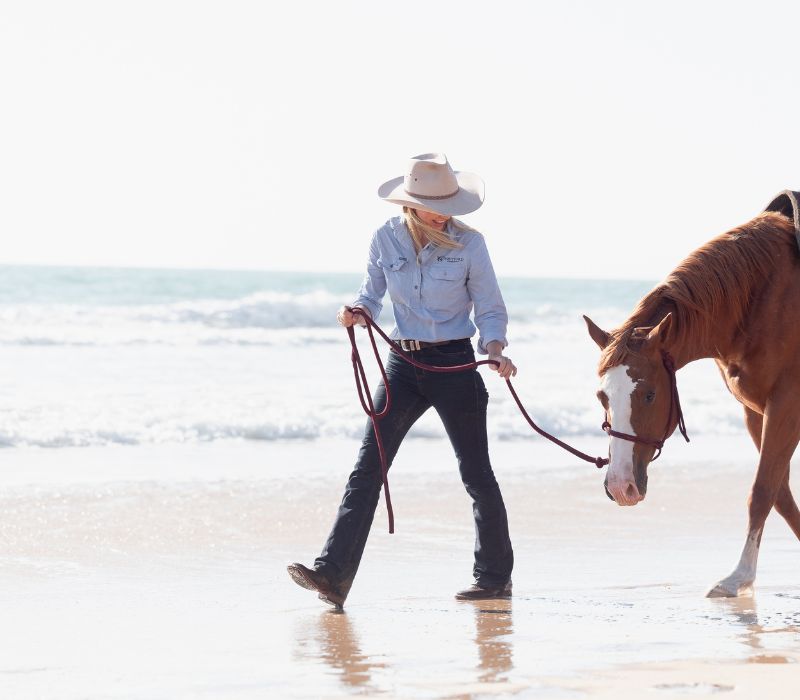
“I have a new rising 8 Australian Stock Horse – he has done outings with his previous owner and on property riding. I ride predominantly by myself and I’m having trouble ‘simply’ getting him down the road. I’ve been advised to pony my mare with him to provide confidence, am I creating a rod for my own back? Should I continue groundwork/connection in hand walking until he can go down the road freely or should I provide a companion when he’s out? ” – Eve
Hi Eve,
It can be so discouraging when things go so well on property in the arena or the areas your horse is familiar with, but when you’ve grown your confidence and you are looking to provide some variety for your horse; it all starts to go downhill – quickly.
A good trail horse is an incredibly valuable and important horse, they have skills which most of us take for granted until we actually need to teach our horses how to do this. Whether your trails are a quiet hack down the road you live on, with a quick canter on the grassy verge or you’re navigating breathtaking trails in the National Park, your horse will still need the same skills: Those skills are;
- navigating varied terrains with confidence (roads, narrow bridges, cars, pedestrians, bike riders, hikers, narrow mountain paths etc)
- solo and group confidence; social confidence
- emotional regulation with unexpected sights and sounds; environmental confidence
- understanding of the aids and confidence in the rider; ridden work confidence
Can you see there’s a bit of a theme starting here? All of this comes back to how confident your horse is – but I’ll bet you had probably already figured that one out!
From your description, your horse seems to lack ‘social confidence’. He lacks the ability to feel secure in his own body when leaving his friends – or in your case your companion mare. This suggests that he needs your mare as a ‘security’ blanket.
The advice you’ve been given to pony them out together isn’t ‘bad’ advice, however it does add an extra step which will make you feel more successful in the short term, but potentially cause a secondary skill to overcome down the track. The thinking behind ponying out with a companion is this: your horse can develop emotional security in his environment, learn how to feel confident on the trail/road whilst using the presence of the secondary horse for support… the theory is that when you take the second horse away, he will have already increased his confidence and will find being solo far more enjoyable. This certainly works, HOWEVER, in my experience, this just creates a bandaid solution and at some point you will have to rip that band aid off and have the other horse leave him, meanwhile he hasn’t actually learnt much at all besides ‘as long as my friend is here, life is fine’. This creates significant separation anxiety along the way.
The way that I would approach this is; position yourself to be the emotional safety blanket for your horse. Your horse should rely on you to help him evaluate his environment. e.g if you’re stressed, your horse might think that you’ve spotted a potential threat, but also, if you’re calm, he can be too. Essentially, you are replacing the role of the companion mare, except, he won’t have to be separated from you on the trail, because well, you’re the one doing the riding or the leading from the ground.
“Ok, but how?!” I hear you yell in frustration at this post…
You can do a number of things to reposition yourself as your horse’s leader, and I have found that a combination of all these works brilliantly.
Spend time doing quality groundwork
No, not groundwork that just forces a horse to move its feet or legs in a certain way until they are ‘obedient’. Nope. I mean the kind of groundwork where he uses his body to open up his mind. So that he can start to see body language as a form of communication , both from him and from you.
Not sure where to start with that? As you’re a Library Subscription member, you can look at the groundwork modules AND the lunging modules too. Lunging should never be about ‘energy out’ but more about helping the horse move his body in a way that prioritises calmness and communication.
Quality groundwork helps you communicate better with your horse. This keeps you safer out in challenging environments like the trail because you know how to move your horse’s body to keep you both safe. Quality groundwork also positions you as a leader because you have prioritised communication and engaging your horse’s mind.
Work on mini challenges together
A mini challenge in a familiar environment is great because you can practice changing a hard ‘no’ from your horse into a willing yes. There are lots of benefits to this.
- you learn how to read your horse’s body language when he is about to start really saying ‘no, I’m out of here’. This is important if you have a horse who regularly pulls away or bolts out on a trail when they are unsure
- you can teach your horse how to keep trying for you.
What is a mini challenge?
Anything out of the ordinary in his regular life. e.g. walking over an old towel, a tarp to step on, a plastic bag tied up to blow in the breeze, or walking under some streamers. Use your imagination, but remember to introduce these scenarios to your horse gradually and build up to it.
Your horse doesn’t need to learn how to step on a tarp on the trail but he does need to learn how to try for you when you ask him to do something he might initially refuse. Set up a behaviour pattern where he learns that not only that you can communicate effectively and calmly, but you also keep him safe. This is the fast track way to position yourself as a leader.
Increase his environmental ‘comfort zone’.
If you got some chalk out and you drew a big ring around boundary of your property where you knew he would happily walk to; that’s his environmental comfort zone. Inadvertently, we teach our horses that there are ‘scary’ areas of our property or beyond: because often, when our horse says ‘ugh, that’s scary, not going over there’ we tend to listen and start to subconsciously avoid going over there. Maybe it’s an unused part of the property with a pile of logs for the winter. If we don’t have a reason to regularly incorporate it into our daily routine, then it becomes a ‘no-go zone’. Let’s say that same area with the logs happened to be on the way to a new turn out paddock you had created for your horse… he might struggle the first few days, but by the end of the week, that area would no longer be an issue, or at the very least, he would be more capable of going there, right? My point is, that the horse quickly learns that they can avoid areas if they aren’t regularly engaged with.
Now, let’s get back to you, Eve, and how this helps your horse.
Next time you visit your horse, ask for one step, just one, beyond that imaginary chalk boundary line. Then turn back again. This teaches your horse a few things
- that your requests are important, but won’t overwhelm him
- that you can understand he is nervous and you can work with him on this
- you challenge him gradually without getting greedy and doing too much too soon – that you understand, see and react to his body language and behaviour.
You can walk towards the chalk line, one step over, then walk back to an emotionally safe space again for a minute or so, then walk back past the chalk line, one or two steps. Then walk back to the safe zone again. You can repeat this over a 15 minute period, then go and do something completely different like riding or grooming or groundwork. The next day, ask your horse to walk 10 steps out and back and out and back.
The slower you go, the more quickly your horse’s confidence will grow and ultimately, his willingness to follow your lead and direction will change for the better too.
Create positive associations
Once your horse can walk maybe 50 metres from your gate, and if it is safe to do so, then give him some hay, or let him pick some fresh grass. Eating is a great way for your horse to regulate and chill out too.
Creating positive associations around leaving that imaginary chalk zone is key to long term success.
Thank you for your question Eve, supporting horses is a marathon not a sprint, and it sounds like your horse is in good hands with a kind, caring owner who wants to do the best for him.
Maddy


